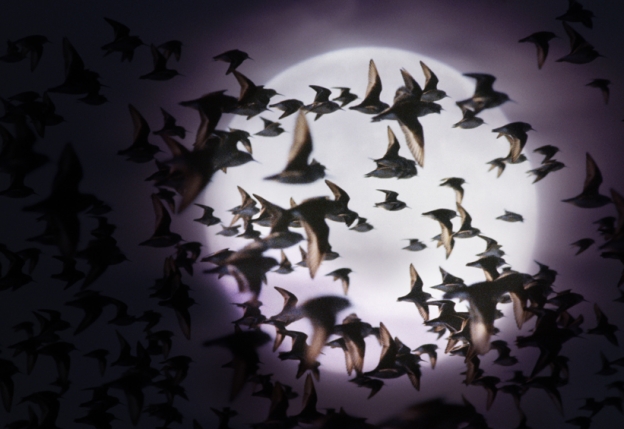
 The sun goes down.
The birds go up.
And Doppler Radar lights up!
Every spring I notice the same trend on Portland’s Live Doppler operated by the National Weather Service office here.
There’s no rain around but suddenly after sunset, there are colors all over the radar map.
Turns out the radar is detecting thousands, possibly hundreds of thousands of birds that migrate in our skies at night!
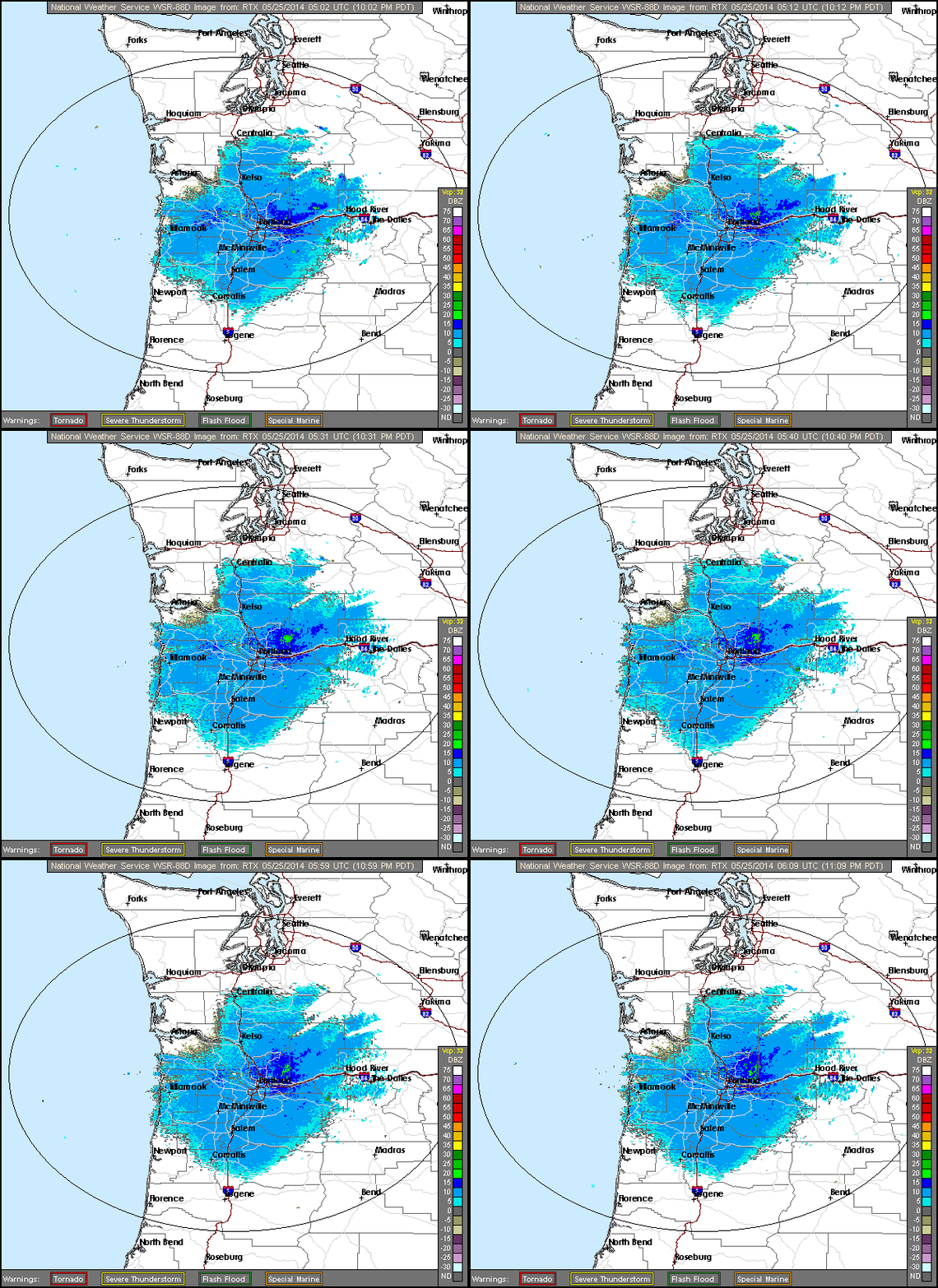
See the blue colors? Those are the birds appearing on radar. This particular radar movie of migrating birds is from about 10pm until just after about 11pm on May 25, 2014. The nearest storm front was still well offshore and skies were actually clear or mostly clear over inland areas.
Clear, that is, except for the birds. So which birds are up there at night? And why are they traveling at night?
This is where it really gets interesting! Scientists at a USGS research center have this to say:
Because most birds are creatures of daylight, it seems remarkable that many should select the night for extended travel. Smaller birds such as rails, shorebirds, flycatchers, orioles, most of the sparrows, the warblers, vireos, and thrushes are typical nocturnal migrants. It is common to find woods and fields on one day almost barren of bird life and on the following morning filled with newly arrived migrants that came during the night.
Observations made with telescopes focused on the full moon have shown processions of birds, and one observer estimated thier passage over his area at the rate of 9,000 per hour. This gives some indication of the numbers of birds in the air at night during migratory peaks. Radar observations have shown that nocturnal migration begins about an hour after sundown, reaches a maximum shortly before midnight, and then gradually declines until daybreak. Bird echoes during peak migration periods may cover a radar screen.
It has to be suggested that small birds migrate by night to avoid their enemies. To a certain extent this may be true because the group includes not only weak flyers, such as the rails, but also the small insectivorous birds, such as wrens, small woodland flycatchers, and other species that habitually live more or less in concealment. These birds are probably much safer making their flights under the protecting cloak of darkness. Nevertheless, it must be remembered that night migrants also include sandpipers and plovers. Most shorebirds are usually found in the open and are among the most powerful flyers, as some of them make annual nonstop migratory flights over 2,000 miles of open ocean.
Night travel is probably the best for the majority of birds chiefly from the standpoint of feeding. To replace the energy required for long flight, it is essential that either food be obtained at comparatively short intervals or stores of fat be laid on prior to migration. If the smaller migrants were to make protracted flights by day, they would arrive at their destination at nightfall almost exhausted. Since they are entirely daylight feeders, they would be unable to obtain food until the following morning. The inability to feed would delay further flights and result in great exhaustion or possibly even death should their evening arrival coincide with cold or stormy weather. By traveling at night, they can pause at sunrise and devote the entire period of daylight to alternate feeding and resting. This schedule permits complete recuperation and resumption of the journey on a subsequent evening after sufficient fat deposits have been restored.
And guess what else? This is far from a silent migration. Some scientists are actually listening to birds migrating at night with special equipment.
Who knew? Now we all do.
Have you every seen birds migrating at night or noticed other evidence that they do?Â
I have never heard of this before. Tonight I am going outside and see the birds-if I can stay awake.
Thanks for this information, Bruce.
George:
Let me know if you see anything. Good luck!
Bruce
BRUCE, THANK YOU FOR THE LESSON. I KNEW THE VALLEY WAS A
FLYWAY, BUT DID NOT KNOW IT WAS VERY BUSY AT NIGHT.
Jim:
Thanks for your post. It is fascinating to me as well!
Bruce
Thanks, Bruce for your blog and for the link to the Audubon article. We miss you but it’s great to see you back on the net!
Melody:
I appreciate your comments–and thanks for stopping by the blog!
Bruce
Bruce,
I had no clue, thanks once again for enlightening me on obscure info. I need to know.
You are the Best!
Patricia
Patricia:
It’s a good conversation starter, for sure. Thanks for your post!
Bruce